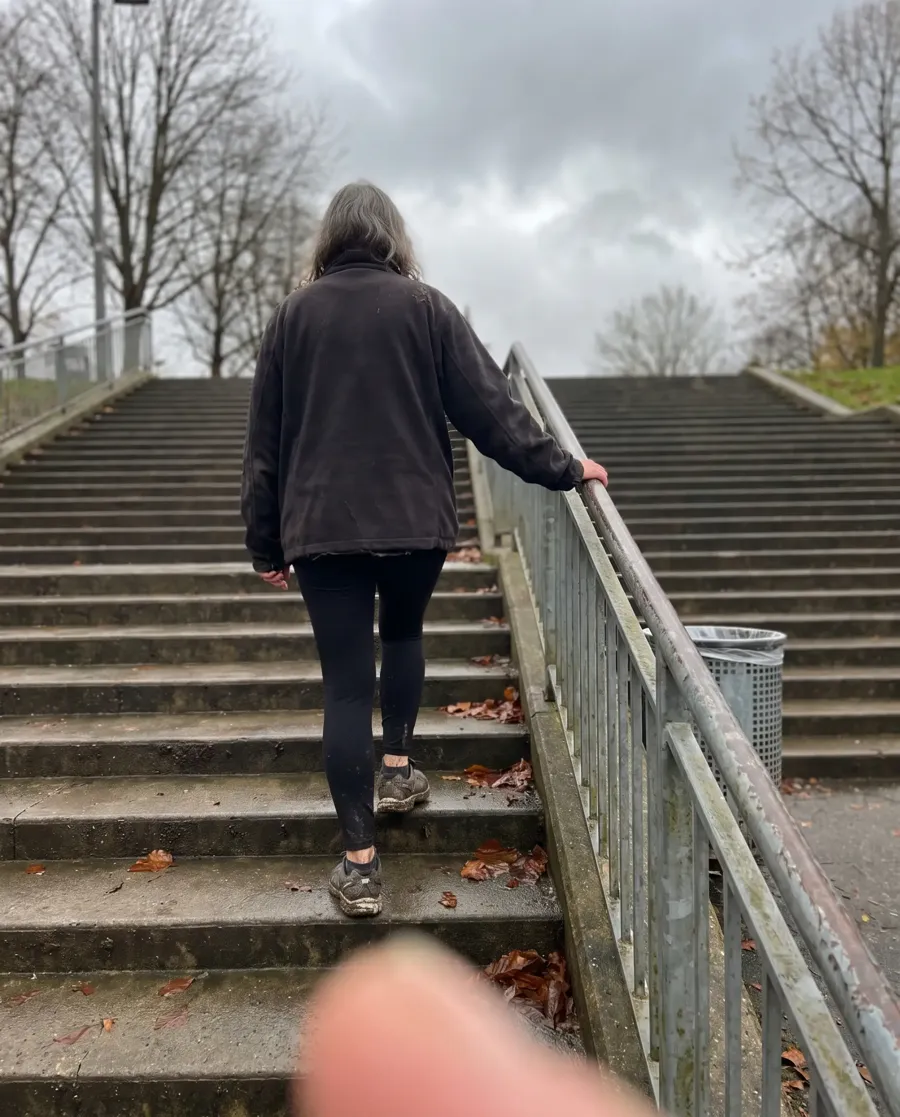
Three miles every morning. In the rain. In the dark. In January.
Dumbbells in my kitchen twice a week.
Seven hours of sleep, and no wine during the week.
All of it because of one sentence.
A neurologist gave a talk at our local library. Maybe forty of us in plastic chairs.
She said the most important tool you have against cognitive decline is your legs.
Strong legs.
That's it. And the whole room wrote it down.
She isn't the only one saying it…
One researcher says leg exercise cuts the chance of dementia by more than a third.
A doctor with millions of subscribers says ninety percent of the stimulation your brain receives comes from movement.
A 2025 paper argues that muscle loss doesn't just come along with cognitive decline. It helps cause it.
Four different people. Tens of millions of views between them.
All saying the same thing.
Move. Build the muscle. Your brain depends on it.
So I built the muscle.
Fourteen months. Three miles a day. Two sessions of weights a week.
Here's what actually happened.
My legs got stronger.
My knees stopped hurting on the stairs.
I went down a dress size.
And my brain got worse.
Not dramatically. Nothing you'd take to a doctor.
Just words going missing a half second longer than they used to.
Just reading the same paragraph three times and giving up on the book.
Just that flat gray feeling at three in the afternoon that a second coffee doesn't touch.
That's the part nobody prepares you for.
You do the thing. Properly. For over a year.
And the thing you were doing it FOR doesn't happen.
I nearly stopped walking.
Not out of laziness.
Out of something closer to insult.
Then I listened to all four of those talks again, back to back.
And I noticed something I had missed for fourteen months.
Every single one of them tells you to move.
Not one of them tells you what the movement runs on.
They hand you the demand.
And they never once mention the supply.
So I went looking for the supply.
Here it is, as simply as I can put it…
Every cell in your body runs on a tiny rechargeable battery called ATP.
Your muscles run on it.
Your brain runs on it.
When it's full, signals fire fast and clean. The word arrives when you reach for it.
When it's empty, the signal stalls. The word is right there and you can't get to it.
Your cells hold only a few seconds of it at a time. It has to be recharged, constantly, all day long.
And the molecule that recharges it is creatine.
Creatine isn't a drug or an herb. Your body already makes it, and it's in you right now.
Mostly in your muscle and your brain. The two hungriest tissues you have.
I always thought creatine was a bodybuilding thing.
Something a nineteen year old buys in a plastic tub at the mall.
Nobody ever told me it was already in my head. Doing a job. Every single time I spoke.
Now here is where it connects back to the walking…
After 50, your own creatine production drops by up to 35%.
And women store roughly 30% less of it than men to begin with.
So I was working with far less of the recharging molecule than I had at 40.
Meanwhile I had spent fourteen months deliberately increasing the demand.
More walking. More weights. More muscle.
All of it drawing on the same energy system.
I turned up the demand on a system nobody told me to supply.
And when supply is short, muscle gets served first.
The brain gets the remainder.
That was the whole answer.
I wasn't doing the wrong thing.
I was doing half of it.
But there was a second problem…
Nearly every tub on every shelf gives you five grams.
Five grams is the muscle dose. Worked out decades ago for young men lifting heavy things.
And if muscle takes first call, five grams disappears before it gets anywhere near your head.
So I looked up what the research had actually used.
Almost none of it was five. Especially in the studies on people our age.
Ten grams was the number that kept coming up.
Five for the body. Five for the brain.
You can't eat your way there. That's about four pounds of steak a day.
I wanted three things.
Plain creatine monohydrate. The boring form with over 700 human trials behind it. Not a "memory blend" hiding a pinch of something behind a trademark.
Ten grams, pre-measured, so I'm not guessing at a scoop at six in the morning.
And I wanted to know where the powder came from.
The one I found was OAK.
👉 oakvitality.com/products/oak-creatine
10 grams per stick. One glass of water. Once a day.
≥99.9% purity, verified, with the third-party results published.
NSF Certified for Sport.
Seven rounds of filtration, vacuum drying and lab testing before it ships.
No scoop. No blend.
And a 90 day guarantee with a full refund, which is the only reason I tried it.
Week 1 and 2. Nothing. I felt slightly silly.
Week 3. I stopped needing the second coffee. I noticed because I made it, drank half, and left it on the counter.
Week 5. Got off the phone with my daughter and realized I hadn't lost the thread once. Not once.
Week 8. The mornings changed. I used to need an hour and two cups before my head switched on. Now it's on when I open my eyes.
The walking is the same. Three miles. I never stopped.
But it feels different now.
For fourteen months I was asking my body for more and giving it nothing extra to do it with.
Now I'm doing both halves.
If you're noticing changes in your memory, please go and get it looked at properly.
Brain fog has a long list of causes and a lot of them are treatable.
But if you have been doing the walking and the weights and the sleep and the diet…
And you have been quietly wondering why the one thing you were promised never showed up…
It might be worth asking what all of it is running on.
Everyone told me to build the muscle.
Nobody told me to feed it.
👉 oakvitality.com/products/oak-creatine
P.S. I'm not telling you to stop walking. Walking is the best thing I do all day. I'm telling you that the advice you were given was true and incomplete, and that the missing half took me three years to find. It shouldn't take you that long.
P.P.S. I don't care which brand you buy. I care that it's plain creatine monohydrate, that the dose matches the research you're relying on, and that whoever made it will show you the test results. If a company won't tell you where their powder is made, that tells you where their powder is made.